


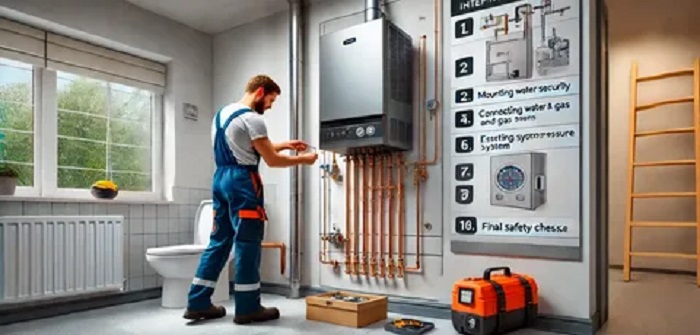
Installing a boiler in a private home affects not only the comfort but also the safety of residents: errors in selecting the right power, piping, or ventilation can lead to excessive fuel consumption, unstable system operation, and emergency situations. Therefore, installation should be considered an engineering project, where calculations, compliance with regulations, and proper commissioning are essential from licensed furnace installers.
Below are practical rules and tips to help you prepare for boiler installation, organize your boiler room, select equipment, and avoid common problems when connecting to heating, gas, electricity, and smoke exhaust.
Preparation: Selecting a Boiler and Basic Calculations
First, determine the boiler type: gas, electric, solid fuel, or combination. The choice depends on energy availability, the allocated electrical power, the chimney’s capabilities, and the autonomy requirements.
How to choose power
Insufficient power will not provide the required temperature in cold weather, while excessive power will lead to frequent switching, decreased efficiency, and accelerated wear. For a rough estimate, the area, heat loss, insulation, climate, ceiling height, and the presence of underfloor heating are taken into account, but the final value is best obtained from a heat engineering calculation.
- Heat loss is more important than area: the same square footage with different insulation requires different power.
- DHW (hot water) increases requirements: for dual-circuit boilers and indirect boilers, an additional reserve is included.
- Operating mode: Condensing boilers are especially effective in low-temperature systems (underfloor heating, low-flow radiators).
Selection of boiler room location and room
The boiler is positioned to ensure access for maintenance, safe distances from walls and equipment, and convenient routing of pipes and the chimney. It’s important to plan for utility lines, space for the expansion tank, manifolds, filters, safety group, and shutoff valves in advance.
- Accessibility: Easy access to the boiler, pumps, filters, and taps.
- Foundation: Durable and non-flammable (especially for floor-standing and solid fuel models).
- Noise: Avoid placing near bedrooms (relevant for boilers with fans and pumps).
- Ventilation: Plan for inlet and outlet ventilation in advance.
Choosing the Power and Type of Heat Generator Based on Area, Insulation, and Climate: Summary
Boiler power is not determined by the area, but by the total heat loss of the house: through the walls, roof, floor, windows, and ventilation, adjusted for the estimated outside temperature in the region and the actual quality of insulation. The same area in different climates and with different insulation levels may require a boiler with significantly different output.
The type of heat generator is selected based on available energy sources, living conditions, automation requirements, and the feasibility of smoke removal/ventilation and fuel storage. A properly selected boiler operates within its modulation range, does not “clock,” provides a stable temperature, and saves resources and fuel.
Practical Selection Algorithm
- Evaluate heat loss: refer to a heat engineering calculation (preferably) or a building inspection/audit; take into account infiltration and ventilation.
- Check the climate: use the estimated minimum temperature for your region; The colder it is, the higher the required power and reserve requirements.
- Check insulation: weak windows, uninsulated roofs/floors, and thermal bridges increase the load more than “extra” square meters.
- Allow a reasonable reserve: 10–20% of the estimated load is usually sufficient; Excessive reserves lead to frequent switching on and reduced efficiency.
- Consider DHW: for a dual-circuit boiler or indirect heating boiler, additional capacity/priority is given to hot water heating (load peaks are short-lived but important).
- Compare the heat generator type with the conditions:
- Gas (including condensing) – if gas is available, low-temperature systems (underfloor heating/large radiators), and a proper flue system are used.
- Electric boiler – if sufficient allocated capacity and tariffs are available; easy to install, but requires an assessment of operating costs.
- Solid fuel – if wood/coal/pellets are available; storage space, chimney, safety, and (preferably) a heat accumulator are important.
- Heat pump – effective with good insulation and a low-temperature system; In cold regions, a backup source is often needed.
- Check compatibility with the heating system: temperature schedule, hydraulics, need for a buffer tank, and the ability to operate in modulation.
Bottom line: the optimal boiler is one whose capacity matches the actual heat loss of the house, taking into account the climate and hot water supply, and whose heat generator type is compatible with the infrastructure (gas/electricity/fuel), the heating system, and installation conditions. This choice reduces costs, improves comfort, and simplifies compliance with safety requirements during installation.