


You arrive to adjust a sticking door. While you’re setting down your tools, the customer asks about a loose towel rail and a curtain rod upstairs. There’s a cabinet hinge to look at, too.
Each sounds like a small job. Taken together, they change the time, materials and equipment the visit will need. If you start straight away, you can end up agreeing on the work without ever agreeing on the price.
A few minutes spent walking through the house can prevent that. Get the full list, check what each repair involves and decide with the customer what you’ll do today. Then you have something solid to put into an estimate.
Start with a walk round the house
Ask the customer to show you everything they want done before you unpack. Finding out about an upstairs curtain rod after putting the ladder away is frustrating for everyone, particularly if you’re already due at another job.
Make a separate note for each task, including the room. A loose handle in the kitchen and one in the bedroom are easy to confuse when you’re taking notes quickly. The description should be specific enough that you can both check it later: adjust the cabinet door, replace one hinge and fit two customer-supplied handles.
Ask which repairs are urgent. The sticking door might need sorting out today; the shelf could wait. That gives you a sensible place to start if the whole list won’t fit the customer’s budget or your remaining time.
Read the list back once. A missing task is much easier to deal with while you’re still discussing the work.
Check what’s actually in the packet
Customer-supplied parts are worth opening before you quote. A curtain rod without suitable wall fixings can mean a trip to the hardware store. A replacement hinge with different screw positions can change how you approach the repair.
Check the rod’s width, the number of brackets and the wall it will be fixed to. Confirm where the customer wants it. For the hinge, compare the new part with the old one before taking the cabinet door off. If they don’t match, you can discuss the options while the cabinet still works.
When you need to supply something, describe it plainly in the estimate. A customer will understand “replacement cabinet hinge” more easily than a general charge for “hardware.” Include any necessary shopping trip in your calculation, and check that you’ve only allowed for it once if several repairs share the same trip.
Access matters as well. If a heavy desk is standing beneath the proposed shelf, agree who will move it and when. Put that arrangement in the estimate rather than arriving to find that each of you expected the other to clear the room.
Agree what you’re doing today
You don’t have to turn a long repair list into a single price for everything. If the customer is watching the cost, quote the essential repairs together and show the shelving as an optional addition. Two clear choices are easier to work through than a different combination for every task.
Explain the shared costs when you discuss those choices. Removing one repair won’t remove the journey to the property or all the time needed to set up. Equally, fitting an extra handle while the tools are out may cost less than making a separate visit for it next week.
Once the customer chooses, make sure you both know what’s included. Name anything being left for another day, along with any parts the customer still needs to provide.
Put the conversation into a usable estimate
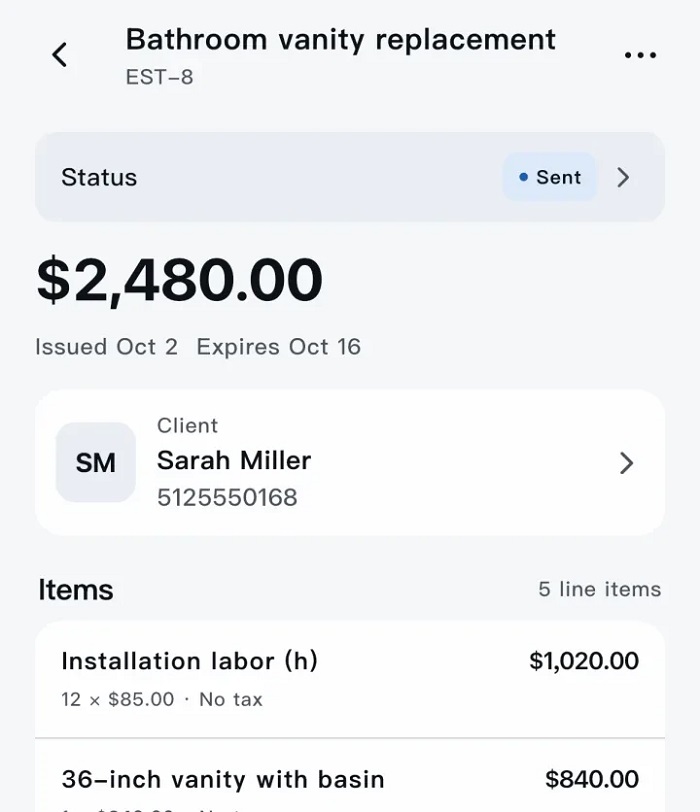
At this point, an estimate should be straightforward to write. You’ve checked the repairs, looked at the parts and agreed on the work. The software needs to carry those details through clearly.
Scope’s handyman estimating software supports reusable services and prices, adjustable quantities, photos and terms. Those features can help you put the estimate together on your phone during the visit.
Saved descriptions still need a quick read. An entry copied from a previous shelving job might include materials you aren’t supplying this time. Check the wording, count the quantities and make sure each repair appears only once.
Scope also supports timestamped customer signatures on your phone. Before asking for approval, go through the estimate with the customer, including the work you’re leaving out. A signature is more useful when the description beside it reflects the conversation you’ve just had.
Price the extra request before starting it
Another request may come up once work is under way. It’s reasonable to say, “I can take a look. Let me check what it needs before we add it to today’s work.”
You might need a different tool, another part or more time than the customer expects. Confirm the additional work and its cost before doing it, and keep their approval with the job record. If it means postponing something else, agree on that too.
Before leaving, walk through the finished repairs together. Check what’s been completed, name anything still outstanding and confirm the next visit if one is needed. Those notes will also give you a clear starting point for the invoice.