


Navigating US salvage auctions like Copart and IAAI demands rigorous financial and technical foresight. Bidders often get captivated by ultra-low hammer prices, forgetting that an auction win is merely the opening line of a complex financial ledger. Without analyzing structural feasibility, true component costs, and potential legal roadblocks, a seemingly lucrative investment can rapidly devolve into a money pit.
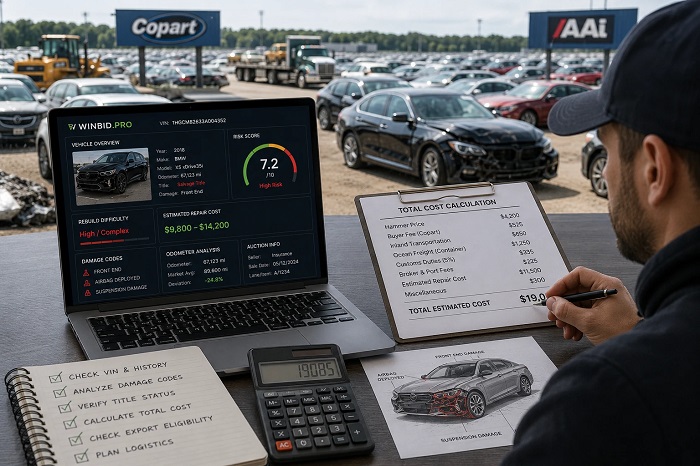
Evaluating the true cost of a salvage vehicle requires looking far beyond the initial bidding price. To establish a realistic budget, buyers must calculate the total cost of acquisition, including auction buyer fees, domestic inland transportation, container shipping, custom duties, and regional registration expenses. Failing to integrate these logistical variables during pre-auction analysis often leads to severe margin erosion.
Beyond Visual Damage: Structural Feasibility Scores
Standard auction listings provide surface-level damage categorizations—such as ‘Front End’ or ‘Side’—which rarely reflect the full scope of mechanical stress. A vehicle with minor cosmetic damage on paper may conceal severe frame deformation, compromised suspension geometry, or subtle hairline cracks in critical engine mounts. Utilizing advanced US auto auction analytics transforms raw data into actionable intelligence. By evaluating historical structural impact metrics alongside similar rebuilding cases, buyers can accurately gauge the true repair difficulty (Rebuild Difficulty) before committing capital.
Factoring E-E-A-T Metrics & Odometer Deltas
An authoritative vehicle evaluation relies heavily on cross-referencing multi-variable data points. A critical metric is the Odometer Deviation Delta, which compares the listed mileage against statistical averages for that specific model year. Significant discrepancies often indicate prolonged storage following a major collision or potential odometer tampering. Furthermore, calculating an automated Risk Score helps buyers identify latent hazards, such as deployed airbag modules requiring factory recalibration or damaged wire harnesses susceptible to short-circuiting.
Title Status and Export Logistics Risk
Even the most mechanically sound salvage vehicle becomes useless if legal restrictions prevent overseas shipment. Certain title designations, such as ‘Bill of Sale’, ‘Junk’, or ‘Certificate of Destruction’, can trigger immediate export blocks at US port customs. Verifying title lineage ensures that the vehicle holds export-eligible documentation like a clean or standard salvage title. Factoring inland towing costs, ocean container freight, and customs clearance into the initial bidding strategy guarantees that unexpected logistical fees won’t destroy your profit margin.
Conclusion
Succeeding at US auto auctions requires shifting from speculative bidding to data-driven decision-making. By thoroughly dissecting damage codes, verifying legal export eligibility, and projecting repair logistics well in advance, you safeguard your business against hidden liabilities. To make informed, profitable bids every time, leverage a comprehensive US vehicle inspection portal to evaluate the complete lifecycle of any lot before the hammer falls.